The Life Cycle of a Jellyfish Explained
The life cycle of a jellyfish is an incredibly interesting one. Over their lives, jellyfish undergo more changes than almost any other animal on Earth. Part of this is down to the fact that they can reproduce sexually and asexually, which has a big impact on how they develop.
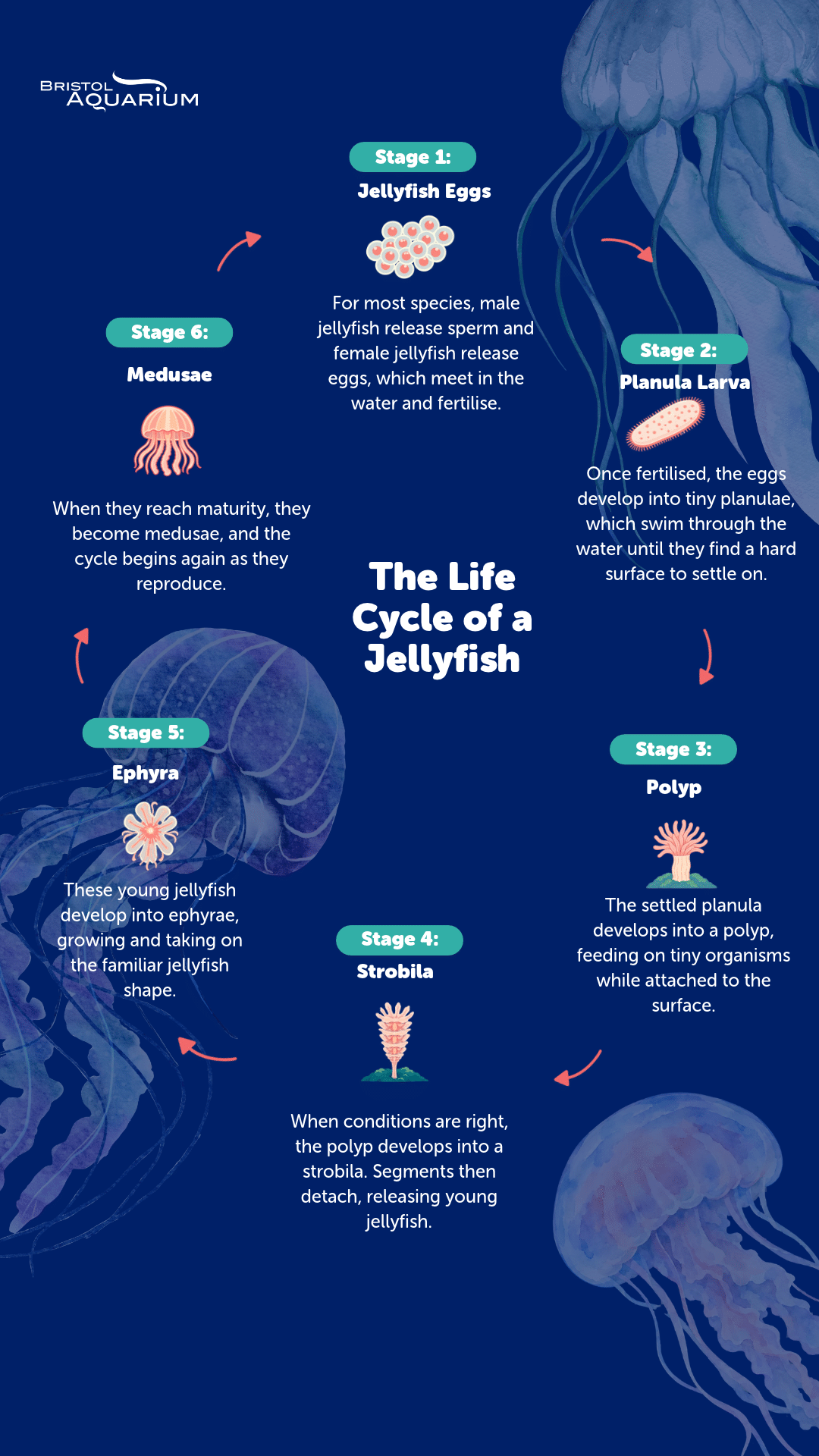
So, from egg to embryo, polyp to medusa, join us for a closer look at the weird and wonderful life cycle of the jellyfish. We’ve also included a free poster for you to download and keep, providing a visual look at all six stages of a jellyfish’s life.
What is a jellyfish?
Jellyfish are marine invertebrates. They belong to a family called cnidarians, alongside corals and sea anemones.
Because they’re invertebrates, jellyfish have no backbone or spine. In fact, they don’t have any bones at all. Amazingly, their bodies are made almost entirely (around 95%) of water and a substance called mesoglea. They rely on water pressure to move around, squeezing muscles in their bell-shaped bodies to change direction.
Jellyfish are found in all the world’s oceans, and there are well over 2,000 known species. Despite their name, jellyfish aren’t fish. They have no backbone, no brain, no heart, and no gills, and that’s what makes them a truly unique creature of the deep.
The life cycle of a jellyfish
Jellyfish are unlike any other organism in our seas and oceans. So where do they come from? How long do they live? And what does their life cycle look like?
We’ll answer these questions and more in our guide to the life cycle of a jellyfish right here.

Stage 1: Jellyfish eggs
The jellyfish life cycle begins when two adults reproduce. But even this looks slightly different depending on the species.
For example, for most jellyfish, reproduction occurs when the male releases sperm and the female releases eggs into the water. When the two join, fertilisation happens.
That’s not the case for all jellyfish, however. Some species, like the moon jellyfish (Aurelia aurita), capture sperm and hold their fertilised eggs in “oral arms” until they develop into tiny larvae called planula.
Other species have a cavity inside their bodies where they store fertilised eggs. In any case, many jellyfish will typically release thousands of eggs to increase the chances that some will develop.
Stage 2: The planula larvae
The next phase of a jellyfish’s life cycle is perhaps the most remarkable. Fertilised embryos transform into larvae called planula, which are tiny, elongated organisms that use hair-like cilia to move in the water.
Even at this stage, planula are totally independent from their mothers. They use cilia to move and drift in ocean currents until they find a suitable hard surface to attach to and begin the next phase of their growth. This might be a rock or a coral reef.
When it finds the right surface, the planula attaches itself, ready to change into a sessile polyp, which is the next stage of the life cycle.

Stage 3: The polyp
When the planula transforms into a polyp, it’s the most dramatic phase of a jellyfish’s life cycle. The organism elongates further and develops a mouth and tentacles.
Polyps are completely stationary, staying in position for months or even years at a time, given the right conditions. They’re carnivorous ambush predators that feed on tiny plankton and other microorganisms, capturing their prey with their long tentacles.
During the polyp stage, asexual reproduction can happen. Polyps are capable of cloning themselves, either through “budding” or “strobilation”. In both cases, the clone eventually detaches, dramatically increasing the jellyfish’s numbers through a totally asexual process.
Stage 4: The strobila
In most cases, jellyfish polyps transform into strobila when the time is right. This process is triggered by environmental changes, such as a drop or rise in water temperature, an increase or decrease in light, or fluctuations in food availability.
As strobilation begins, the polyp reabsorbs its tentacles and develops deep horizontal grooves along its column. It starts to look exactly like a stack of dinner plates, with distinct segments from top to bottom.
Each of these segments is a young jellyfish, and as they develop, they grow arm-like lobes which will eventually become tentacles. As the strobila reaches full maturity, it begins to pulse, triggering each young jellyfish to detach from the top down.

Stage 5: The ephyra
The young jellyfish that detach from the strobila are called ephyra. These free-swimming creatures, with their developing tentacles, start to resemble the typical jellyfish shape.
Ephyra are tiny, usually only a couple of millimetres wide. Although they do have a slight bell shape, they’re more like stars, with multiple arms and lobes protruding from every side.
Swimming freely, ephyra pulse their lobes to propel forwards through the water. They feed on planktonic microorganisms, pushing their tiny prey into their mouths.
As they grow over a period of weeks or months, ephyra gradually develop the large bell-shaped dome, oral arms and tentacles of an adult jellyfish.
Stage 6: The adult jellyfish
When ephyra reach full maturity, their development into adult jellyfish, or medusa, is now complete.
Adult jellyfish are known for their dome-shaped upper body, which is called the bell. Directly beneath this is the mouth and oral arms, followed by the tentacles that are used to capture prey.
Jellyfish move by contracting muscles in their bell. This pushes water out, propelling the jellyfish forwards.
Unlike other stages of a jellyfish’s life cycle, medusae develop into distinct sexes – male or female. It’s the role of the medusa to reproduce and cross-fertilise, beginning the life cycle all over again.

How long do jellyfish live?
How long a jellyfish lives depends on the species. Some live for a matter of weeks, others for a few years, while some may even be immortal.
Environmental factors can have a big impact on the lifespan of a jellyfish. In the open ocean, changing temperatures and rough currents can shorten a jellyfish’s life.
Download our free jellyfish life cycle poster!
See how a jellyfish’s life unfolds with our free downloadable poster, the perfect educational resource for anyone interested in the different stages of a jellyfish’s unique, extraordinary life.
Download jellyfish life cycle poster here.
See jellyfish at Bristol Aquarium
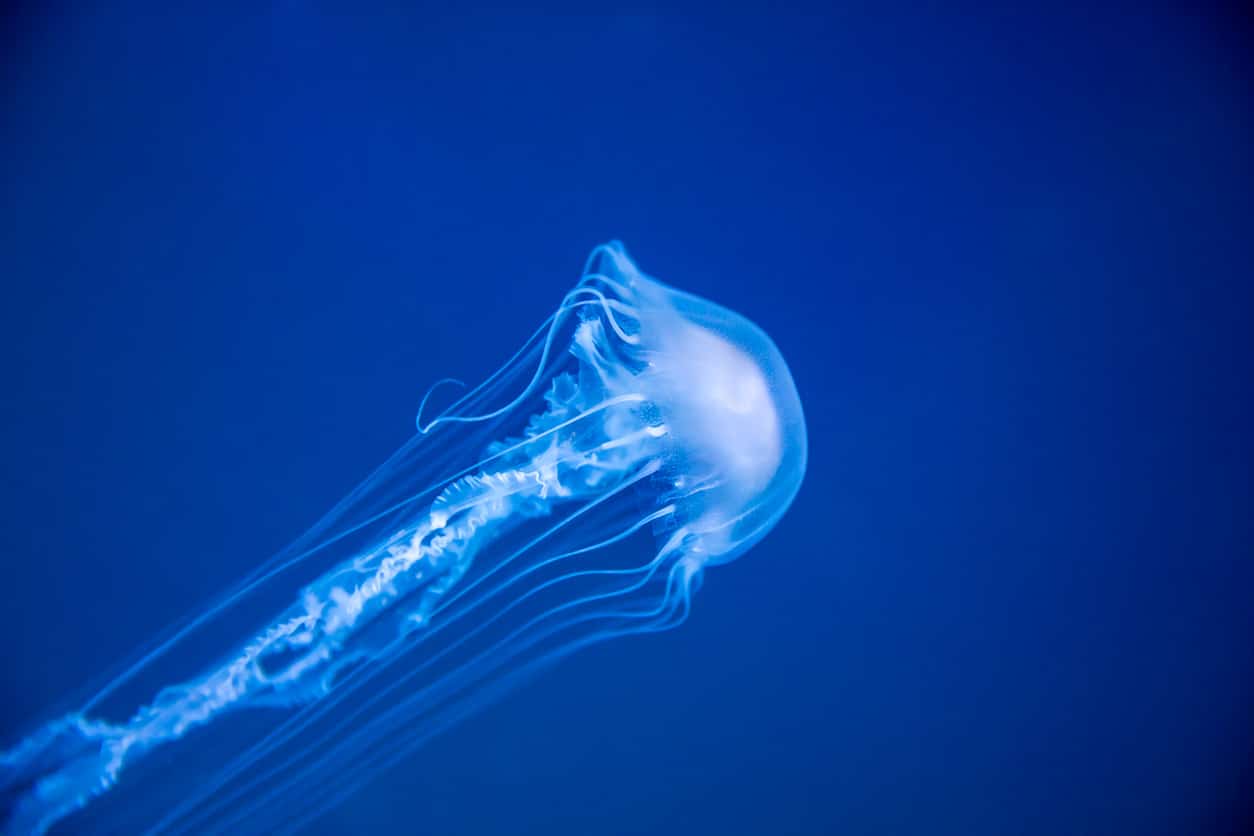
Here at Bristol Aquarium, we’re proud to play host to some curious jellyfish species in our Sunken Shipwreck exhibit, including our very own moon jellyfish. Watch how these amazing creatures propel themselves through the water and use their long tentacles to catch their prey.
To see these incredible creatures and more, book your tickets to Bristol Aquarium today.