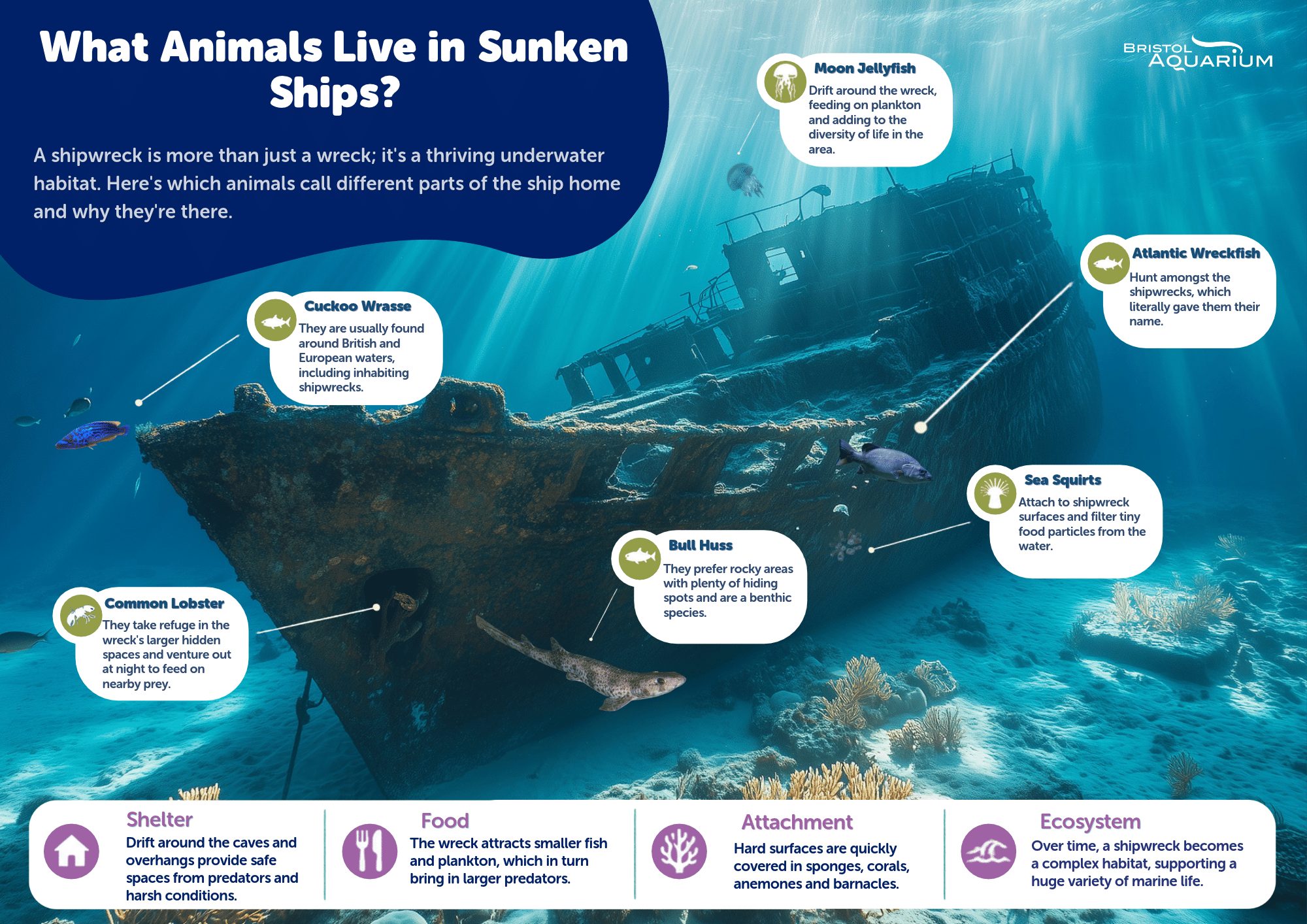
Shipwreck Habitats: What Animals Live in Sunken Ships?
From the Atlantic seaboard to the wilds of Australia’s Pacific coast, the world’s oceans are strewn with shipwrecks – remnants of voyages lost to the deep blue. But while such sites are certainly poignant, they do have one upshot: providing an unexpected habitat and safe haven for dozens of marine species.
You see, when a ship sinks to the ocean floor, it doesn’t take long for nature to take over. Fish, crustaceans, coral, and anemones quickly move in, transforming wrecks into artificial reefs on the seabed.
So, exactly what kind of animals are you likely to find in sunken ships? And why are these hulking wrecks such a hit with marine life on the seafloor?
Here, we’re taking a closer look at the myriad of species that make a home in shipwrecks, along with why these unique man-made habitats are so invaluable to the creatures that live in and around them.
How do shipwrecks become habitats in the ocean?
Shipwrecks are known to play host to a remarkable and complex array of life. But how exactly do these manmade, out-of-place structures become thriving marine habitats?
Well, when a shipwreck settles on the seafloor, it provides a solid surface for organisms to attach to. Many micro-organisms and animal species rely on hard surfaces for growth or rearing their young, so a wreck is often a welcome, not unwanted, addition to the seabed.
Initially, organisms like algae, bacteria, barnacles, mussels and sponges grow on wrecks, which then attract progressively larger animals. Over time, a more complex ecosystem develops amid the wreck, with the ship’s rooms and passageways allowing a surprising number of species to live in harmony with one another.

Why do marine animals live in shipwrecks?
Shipwrecks may seem like the most unlikely of places to find marine life on the seafloor. After all, sunken ships are known to cause widespread damage to underwater ecosystems, both from the initial impact of hitting the seabed and the long-term effects of pollution and corrosion.
Despite this, marine creatures and plant life love them. Whether just off the UK coast or in the bowels of the Atlantic Ocean, shipwrecks teem with animals, plants, and anemones of every persuasion, to the point where they’ve become some of the world’s most invaluable marine habitats
So, why is this? Well, there are several reasons that biologists are happy to agree on, including:
- Wrecks are the perfect solid substrate for coral growth: Typically, coral grows on rock, which is the ideal solid substrate needed for the creature to flourish. Wrecks mimic this habitat, resulting in the development of artificial reefs that attract a wide array of life.
- Spores, spawn, and larvae cling to sunken ships: In an otherwise barren environment, the spawn of animals and plants cling to shipwrecks for shelter, feeding on nutrients from the surrounding coral and plant life.
- Predators and prey use shipwrecks for shelter: While some fish species seek refuge in sunken ships, predators use their shadowy enclaves to ambush their prey. Indeed, some of the biggest fish in our oceans, including the mighty goliath grouper (Epinephelus itajara) and fearsome great barracuda (Sphyraena barracuda) have been observed using shipwrecks as a vantage point from which to spring a trap on their unsuspecting prey.
Which animals live in shipwrecks?
As we’ve established, a surprising variety of life lives in sunken shipwrecks – far too many animals to list in a single blog post, in fact. So, with that in mind, here’s a look at a few of our favourite wreck-dwelling species, some of which are on display in our specially curated Sunken Shipwreck exhibit here at Bristol Aquarium.
Atlantic wreckfish (Polyprion americanus)
Also known as the stone bass, the Atlantic wreckfish quite literally gets its name from hunting around shipwrecks. They are known for living in deeper water, living amongst deep rocky reefs, caves and drop-offs, which is incidentally where shipwrecks can be found. Atlantic wreckfish are found across the world.

Cuckoo wrasse (Labrus mixtus)
The cuckoo wrasse are brightly coloured and are usually found around British and European waters, including inhabiting shipwrecks due to their marine life hotspots. There are a number of shipwrecks around the UK that have become well-known for cuckoo wrasse populations, including off the coast of North Cornwall, Falmouth Bay and the British Channel Islands.
Bull huss sharks (Scyliorhinus stellaris)
The bull huss, also known as a nursehound, is a species of catshark typically found in the coastal waters of the northeastern Atlantic and Mediterranean Sea. They prefer rocky areas with plenty of hiding spots and are a benthic species, so it’s no wonder they are found amongst shipwrecks near the seabed.
Moon jellyfish (Aurelia aurita)
The moon jellyfish (Aurelia aurita) is a saucer-shaped jellyfish found in coastal waters around the world, including here in the UK. They often gather around shipwrecks to feed on tiny microorganisms like plankton, as well as on fish eggs and larvae. Since shipwrecks have a localised effect on water currents, this can naturally lead jellyfish to congregate in large numbers seeking shelter.

Common lobster (Homarus gammarus)
The common lobster (Homarus gammarus) needs no introduction. Known for their blue shells and powerful claws, these large crustaceans are found in the Mediterranean Sea as well as around the UK coast. Lobsters use shipwrecks as shelter when they’re moulting (shedding their old shell), while they also provide the animal with an abundant source of food.
Sea squirts (Ascidiacea)
Sea squirts (Ascidiacea) might look more like sponges or plants, but they are animals, and belong to the family Tunicata. Their sac-like bodies are usually cream, orange, or yellow, and they feed on plankton, bacteria and other microorganisms which – you guessed it – are prevalent among shipwrecks.

Famous British shipwrecks and their marine life
Who knows just how many ships lie wrecked off the UK coastline? Our shores are home to some of the world’s most famous shipwrecks, all of which are home to an incredible array of marine life.
Let’s take a closer look at some of the notable wrecks in our seas.
HMS Scylla, Cornwall
If you were looking for proof that shipwrecks can provide vital marine habitats, the wreck of the HMS Scylla is a great example. This former Royal Navy warship was deliberately sunk off the Cornish coast in 2004, with the intention of creating an artificial reef off England’s south-west coast.
Today, the wreck of the HMS Scylla is teeming with marine life, from sea squirts and starfish (Asterias rubens) to ballan wrasse (Labrus bergylta) and tubeworms.
SS James Eagan Layne, Whitsand Bay
The wreck of the SS James Eagan Layne is one of the UK’s most important underwater habitats, known for species like the conger eel, tompot blennies (Parablennius gattorugine), pollack (Pollachius), and John Dory (Zeus faber). The wreck attracts an extraordinary array of life, though it is under threat from underwater corrosion and over-diving.
While the wreck of the SS James Eagan Layne is treasured as a marine habitat today, its story is a sad one. The ship was torpedoed by a German U-boat during the Second World War, and sank to the bottom of Whitsand Bay at a depth of around 24 metres.
Shipwrecks around the Isles of Scilly
Hidden rocks, strong currents and exposed waters have made the Isles of Scilly a notorious maritime hazard for centuries. It’s thought that more than 700 wrecks have been recorded off the Scilly Isles, leading sailors to nickname the region the “graveyard of rocks”.
While the Isles of Scilly may have a notorious reputation among sailors, the area is a treasure trove of marine life. Spider crabs, cod (Gadus), sea urchins (Echinoidea), wrasse (Labridae), and dead man’s fingers (Alcyonium digitatum) have all been observed amid the wrecks of the Scilly Isles.
Download our free shipwrecks marine life poster!
Download our fascinating shipwrecks sea life poster, complete with many of the species you’ll find among wrecks right here in the UK.
That’s just a handful of the incredible species that can be found living among sunken shipwrecks at the bottom of the ocean floor. To learn more about the wonderful world of wrecks and the unique habitats they provide, why not join us with a visit to Bristol Aquarium? Get your tickets here.