
One of the most common questions we receive from curious younger visitors at Bristol Aquarium is about the movement of the sea. It’s easy to assume waves are just for surfers or splashing about in at the beach, but they also play an important role in the survival of our marine ecosystems.
In this blog, we’ll explore the science behind these moving waters and discover exactly why they’re so vital for ocean life.
What is an ocean wave?
To understand waves, it helps to picture the surface of the sea. Although it looks as though the water is rushing towards the shore, the water itself doesn’t actually travel very far. A wave is actually just energy moving through the water. If you were to watch a seabird sitting on the surface, you would notice it bobbing up and down in a circular motion rather than moving forward with the wave.
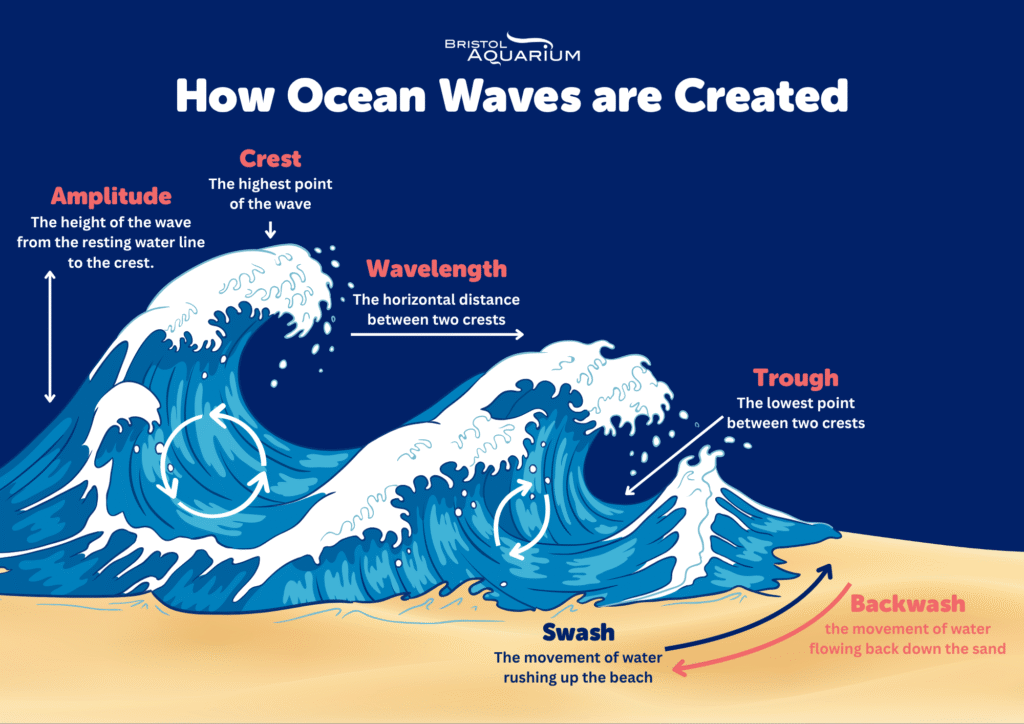
We can break a wave down into a few key parts. The very top of the wave is known as the crest, while the lowest point between two waves is called the trough. The horizontal distance between two crests is the wavelength, and the amplitude is the height from the still water level to the crest.
This movement is created by energy passing through the water, which is usually caused by wind, but can also be influenced by the gravitational pull of the moon or sudden movements from the seabed, like an earthquake.
Types of waves
Not all waves are the same, and distinguishing between them helps us understand the ocean better.
Wind waves
Wind waves are the most common type you will see at the beach, created by local winds blowing across the water.
Swells
Swells are different because they’ve travelled a long way from where they started. These are smoother, rolling waves that carry energy across vast distances of the ocean.
Tsunamis
Tsunamis are rare and powerful. These are not caused by wind but by seismic events like underwater earthquakes, landslides, or volcanoes that displace huge amounts of water.
Tidal waves
Tidal waves are often confused with tsunamis, but they’re actually caused by the gravitational pull of the moon and sun, resulting in the rise and fall of the tide.
What causes waves in the ocean?
The primary creator of waves is the wind. As wind blows over the smooth surface of the ocean, friction transfers energy to the water. This initially forms tiny ripples. If the wind continues to blow steadily and strongly, these ripples grow into the larger waves we recognise.
While the wind handles the surface, the moon plays a part too. Its gravity pulls on the oceans, creating tides. While this is different from a crashing wave, the movement of tides does influence how waves form and behave near the coast.
Deep underwater activity can also be a cause. If there’s an earthquake or a volcanic eruption on the sea floor, the sudden movement pushes water upwards and outwards, creating massive waves like tsunamis.
It’s also worth noting that we have surface waves, which are what we see on top of the water, and internal waves. Internal waves happen deep underwater between layers of water that have different densities, often dragging nutrients across the ocean without us ever seeing them from the surface.
When waves finally reach the shore, we see two specific actions. Swash is the foaming water rushing up the beach, depositing sand and shells. Backwash is the water draining back into the sea, pulling material with it. This constant exchange is what shapes our beaches.
Diagram of ocean waves
How big can ocean waves be?
Ocean waves have an incredible range in size. They can be tiny ripples that you can barely see, or they can be massive walls of water. The size depends on three things: how fast the wind is blowing, how long it blows for, and the “fetch”, which is the distance the wind travels over open water.
In the open ocean, particularly in the Southern Hemisphere, where there is little land to stop the wind, waves can grow to enormous heights. There have been records of waves reaching over 20 to 30 metres during extreme storms. These are very different from your typical beach waves. Tsunamis can also reach great heights as they approach land, though they often travel almost unnoticed in deep water.
The size of the wave matters for marine life. Gentle waves create safe nurseries for small fish, while rougher, larger waves oxygenate the water but can make it difficult for some creatures to settle.
What is erosion?
You may notice that coastlines change over time, and this is largely due to erosion. This is the process where the sea wears away the land.
Hydraulic action
This is when the sheer power of the waves crashes against cliffs, forcing air into cracks and breaking the rock apart.
Abrasion
This happens when waves pick up rocks and pebbles and hurl them against the cliff face, acting like sandpaper.
Attrition
This is where rocks carried by the sea knock into each other, slowly becoming smaller, smoother, and rounder.
Corrosion
This involves the seawater chemically dissolving certain types of rock, such as limestone or chalk.
Why waves matter for marine life and ecosystems
Waves are the heartbeat of the ocean. They act as a giant mixing spoon, circulating oxygen from the atmosphere into the water. Without this aeration, many marine species would struggle to breathe. They also transport vital nutrients and plankton across the globe, ensuring food reaches the stationary creatures like coral and barnacles that rely on the current to bring dinner to them.
Waves also help create diverse habitats. The rock pools you might explore on a visit to Bristol are refreshed by the waves, providing a home for crabs, starfish, and anemones. The movement of water influences how animals breed and feed; many fish species rely on currents to disperse their eggs to new areas.
However, the balance is delicate. Strong waves can shape coastlines and damage kelp forests or coral reefs if they are too frequent or powerful. Human activity, such as building too close to the coast or climate change altering weather patterns, can change how waves behave. This can lead to increased erosion or habitat loss, which is why protecting our oceans is so important for the future of marine life.
If you’d like to see some of the incredible creatures that thrive because of ocean waves, a visit to Bristol Aquarium is a fantastic way to see these adaptations in action. To plan your next marine adventure and observe our incredible exhibits, book your tickets now!