What are Carnivorous Plants?
Carnivorous animals, like lions, crocodiles and polar bears, are cunning predators, highly adapted to eat animal meat, with some needing to in order to survive.
So, when you think about carnivorous plants, it might be a little confusing how they’re able to consume animal meat just like the species above. Well, they’re just as good at digesting animal meat (although nothing like the size of an antelope), but they use a concoction of special enzymes and acids o break down the small insects that they catch. It’s an utterly unique adaptation, which makes them more than worthy of an entire blog talking about their adaptations.
In this blog, we’ll be explaining what a carnivorous plant is, how it’s different from normal plants, the types of carnivorous plants, and the ingenious ways that these plants catch and digest their prey.
What Is a Carnivorous Plant?
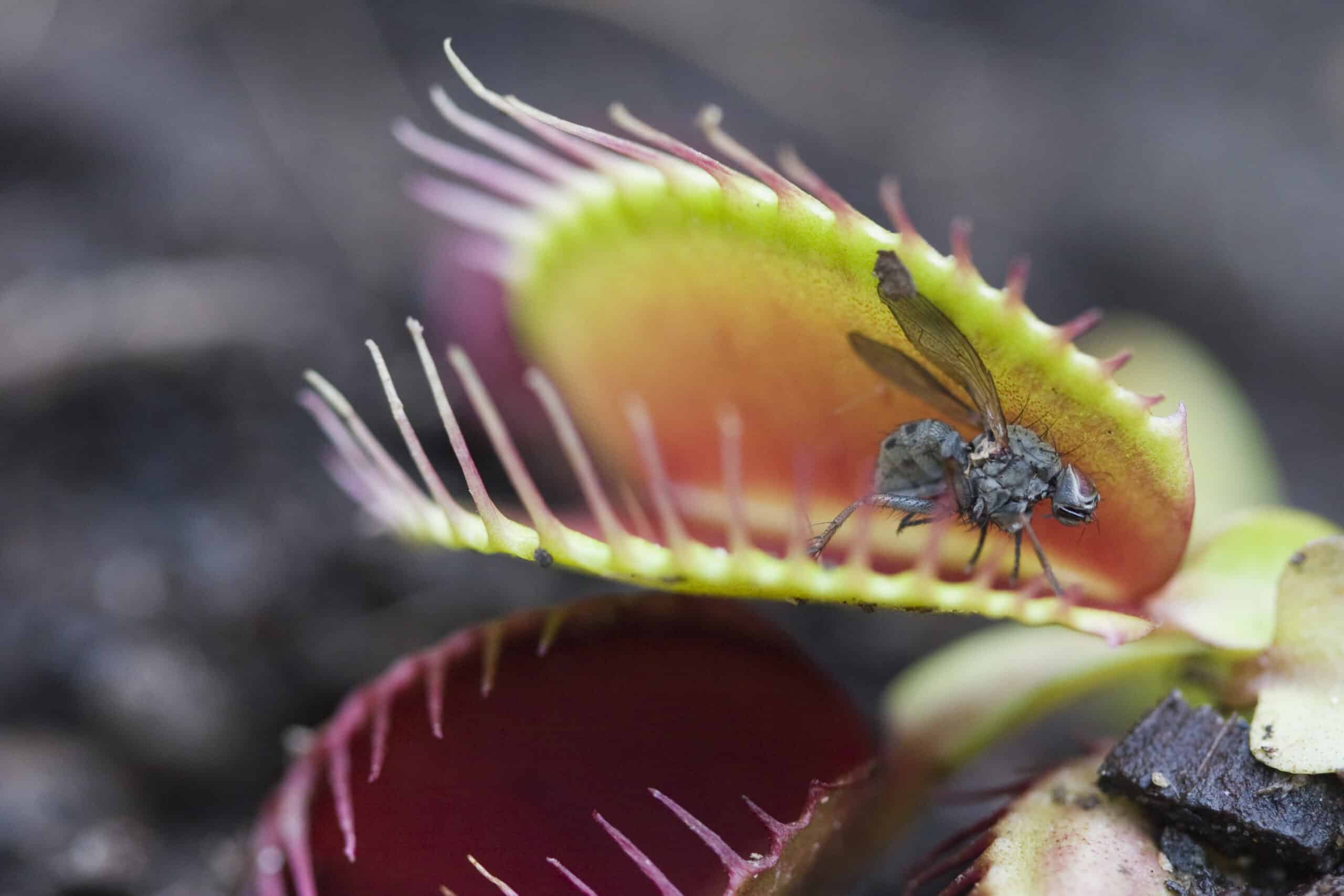
Carnivorous plants, like their counterparts in the animal kingdom, rely on animal matter as a source of nutrients. Plants like Venus flytrap attract insects to land in their jaw-like leaves using a combination of colour, light, and nectar-lining on their leaves.
How are carnivorous plants different to normal plants?
Normal plants get all the nutrients that they need from the sun and the soil. In areas where soil is lacking nutrients, plants evolved to get those nutrients from animals.
Across the world, there are several areas that are infamous for their lack of nitrogen-dense soil. For example, approximately 64% of soil samples from India are found to be low in nitrogen, something that’s vital for the proper development of plants.
Carnivorous Plant Species
Carnivorous plants come in a variety of shapes and sizes and can be found across the globe. While they might look different and have slightly different adaptations, they all share the remarkable ability to catch live prey.
Venus flytrap
The Venus flytrap is probably the most famous example of a carnivorous plant with only one species (Dionaea muscipula)!. Their jaw-like leaves have incredibly sensitive hair triggers that snap their trap shut when an insect disturbs them. While the insects are busy drinking the sweet liquid, the plant closes the “lid” and traps the insect inside. The plant then releases its digestive enzymes to digest the insect.
Wilmington in North Carolina and some areas of South Carolina are the only places they’ve been found growing naturally.
Pitcher plants
The term “pitcher plant” generally refers to members of two plant families, the Nepenthes (goblet pitchers) and Sarracenia (trumpet pitchers). Pitcher plants have pitfall traps, uniquely shaped leaves that lure insects insect to fall in, with no escape! The edges of the plants are coated with nectar filled with digestive juices that is irresistible to insects. The inside of the trap is slippery and designed to cause one way trips down into the stomach-like digestive juices at the bottom.
Pitcher plants are far more widespread than Venus flytraps. They can be found in Southeast Asia, Madagascar, Australia, the United States and Canada.

Sundews
Sundews offer another example of carnivorous adaptation. Their leaves are covered in gluey nectar-tipped tentacles. Insects are attracted to the nectar, land on the leaves and become stuck. The leaves then curl up, and the digestion process begins. Sundews have adapted sticky leaves in a variety of forms from the small, flat, spoon-shaped varieties (e.g Drosera spatulata) to the tallest, almost tree-like sundew able to grow to 1.5M tall (Drosera gigantea).
Sundews are found on every continent except Antarctica, even being found in acidic, nutrient-poor, waterlogged habitats like peat bogs, heaths, and moorlands, with 3 species even native to the UK!.
Bladderworts
Bladderworts (Utricularia) are unusual plants usually aquatic or found in moist environments, they are made up mainly of a series of roots that contain tiny traps. Bladderworts use their bladder-like traps to attract prey and then use a suction mechanism to trap insects inside.. The plants are often only noticeable when they send out their delicate, tiny flowers in a variety of colours! Often cultivated for their flowers, which are often compared with those of snapdragons and orchids.
Their traps aren’t as big as the jaws of a Venus flytrap, so they rely mainly on catching small prey like mosquito larvae. While bladderworts can be found worldwide, they’re most likely to be found in swamps across the east coast of the US and Canada.

How Do Carnivorous Plants Catch Their Prey?
Carnivorous plants catch their prey in a variety of ways. They primarily attract their prey by using sweet-smelling nectar that insects love.
From there, the trapping process might differ from plant to plant. Some plants, like the Venus flytrap and sundews, close their leaves tightly around the trapped insect before digesting it. While others, like pitcher plants, trap insects in a slippery tube full of digestive fluids!
Where Do Carnivorous Plants Grow?
Carnivorous plants are a product of the environment they’re found in. Plants typically get all the nutrients that they need from the sun and from soil, but in some environments, nutrients like nitrogen are lacking.
In these cases, the plants must adapt to survive. They did this by gradually evolving tactics to attract and trap insects, obtaining the nitrogen locked within their tissues.
There are various reasons why an area might be lacking nutrients in its soil, for example, the soil type, the amount of rainfall, intensive farming stripping the soil of its nutrients, etc.
You’ll find a high concentration of carnivorous plants in tropical and subtropical regions, wetlands, bogs and peat soils, and acidic and alkaline soil, to name just a few.
We’ve recreated the environment of the tropical regions in the Jungle Exhibit at Bristol Aquarium, where you can find carnivorous plants as well as animals like stingrays, poison dart frogs and piranhas.

Why are Carnivorous Plants Important?
Carnivorous plants, much like carnivorous animals, benefit the ecosystems that they live in in a variety of ways. Even though they catch insects in their traps, they also help insects to pollinate plants.
They also help to keep populations in check by eating species that might otherwise start to dominate an ecosystem.
In order to protect the delicate balance of these ecosystems, conservation efforts must be made to protect carnivorous plants.
Learn More about Carnivorous Plants at Bristol Aquarium
At Bristol Aquarium, we’re incredibly lucky to house several species of carnivorous plants within our Rocky Shores and Urban Jungle exhibits. Aquariums aren’t just about water and fish; they’re about faithfully recreating the natural environments that these animals exist in, which means recreating the plants, too. Here’s some of the carnivorous plants we have here at the aquarium:
Purple pitcher plant
The purple pitcher plant (Sarracenia purpurea) uses its veined purplish-red trumpet pitchers- to trap insects, using a sweet nectar to attract insects from far and wide and lure them to a slippery death! Its leaves are usually thick and short arranged in a circle, often with tall, unusual flowers towering above the traps (to avoid eating their own pollinators!)
Monkey jar plant
The monkey jar plant (Nepenthes khasiana ‘Gaya’) is a type of tropical climbing vine, with goblet style pitchers (hence the nickname ‘monkey jars’). This plant native to Southeast Asia – particularly areas like Borneo, Madagascar and the Philippines and lures insects to fall into their traps. Some larger species of nepenthes don’t attract insects at all, with some even acting as a ‘toilet bowl’ for small mammals, enticing them in with a sugary nectar and encouraging them to take a seat! These plants utilise the nutrients from animal waste, instead of trapping insects (e.g. Nepenthes lowii).
Book your tickets today to come and learn more about these fascinating plant species!


