How Aquatic Animals’ Teeth Are Made for Their Diet
Across the animal kingdom, teeth come in countless shapes and sizes. The great white shark (Carcharodon carcharias) has up to 300 large, razor-sharp teeth that are specially adapted to catch and kill prey. The Etruscan shrew (Suncus etruscus) – the smallest mammal on earth – on the other end of the spectrum, has only 30 tiny teeth in its mouth, and while they’re still designed for hunting prey, they’re vastly different from the teeth you’d find in a great white’s mouth.
Teeth have changed over millions of years to be adapted to each animal. Even our closest relative, the chimpanzee (Pan troglodytes), has incredibly different teeth compared to humans to allow them to eat fibrous vegetation and defend their territory, something humans don’t have much need for anymore.
In this blog, we’re going to embody our inner veterinary dentist to explore the world of animal teeth and why they’re so different across the animal kingdom.
Why do teeth vary between aquatic animals?
In the underwater world, teeth are more than just tools for chewing; they are finely tuned instruments that evolve in response to diet and feeding behaviour. For marine life, the shape of a tooth can be the difference between a successful hunt and a missed meal. While land animals often rely on a standard set of molars and incisors, aquatic species have developed a fascinating array of dental hardware.
Generally, these adaptations fall into three categories:
- Carnivores: Equipped with sharp, pointed teeth designed to grip and tear fast-moving prey.
- Herbivores: Often feature flatter teeth or specialised structures for grazing on tough algae and coral.
- Omnivores: Possess a mix of types of teeth, providing the flexibility needed to switch between different food sources.
Of course, the ocean is full of surprises. In the water, feeding isn’t always about biting. Many species have mastered alternative strategies like suction feeding, crushing thick shells, or even filter feeding, where teeth are replaced by fine sieves to catch tiny plankton.

Carnivore teeth in aquatic animals
For the ocean’s top predators, teeth must be sharp, durable, and ready for action. Sharks are perhaps the most famous carnivores in our tanks. Unlike humans, who only get two sets of teeth, sharks are tooth-producing machines. They continuously replace their teeth throughout their lives, with new ones moving forward like a conveyor belt to replace those lost during a hunt. Because of this constant cycle, you can often find shark teeth available to purchase as a souvenir at the Bristol Aquarium gift shop!
Carnivorous aquatic animals, such as the moray eel (Muraenidae) or the powerful grouper species you can find here at Bristol, use needle-like or serrated teeth to ensure that once they grab a meal, it cannot escape.
Herbivore feeding adaptations
Not everyone in the ocean is looking for a fight. Many aquatic animals feed mainly on plants, algae, or coral, meaning that, instead of sharp fangs, these herbivores often have flat teeth for grinding or even a beak-like structure for snapping off pieces of hardy vegetation.
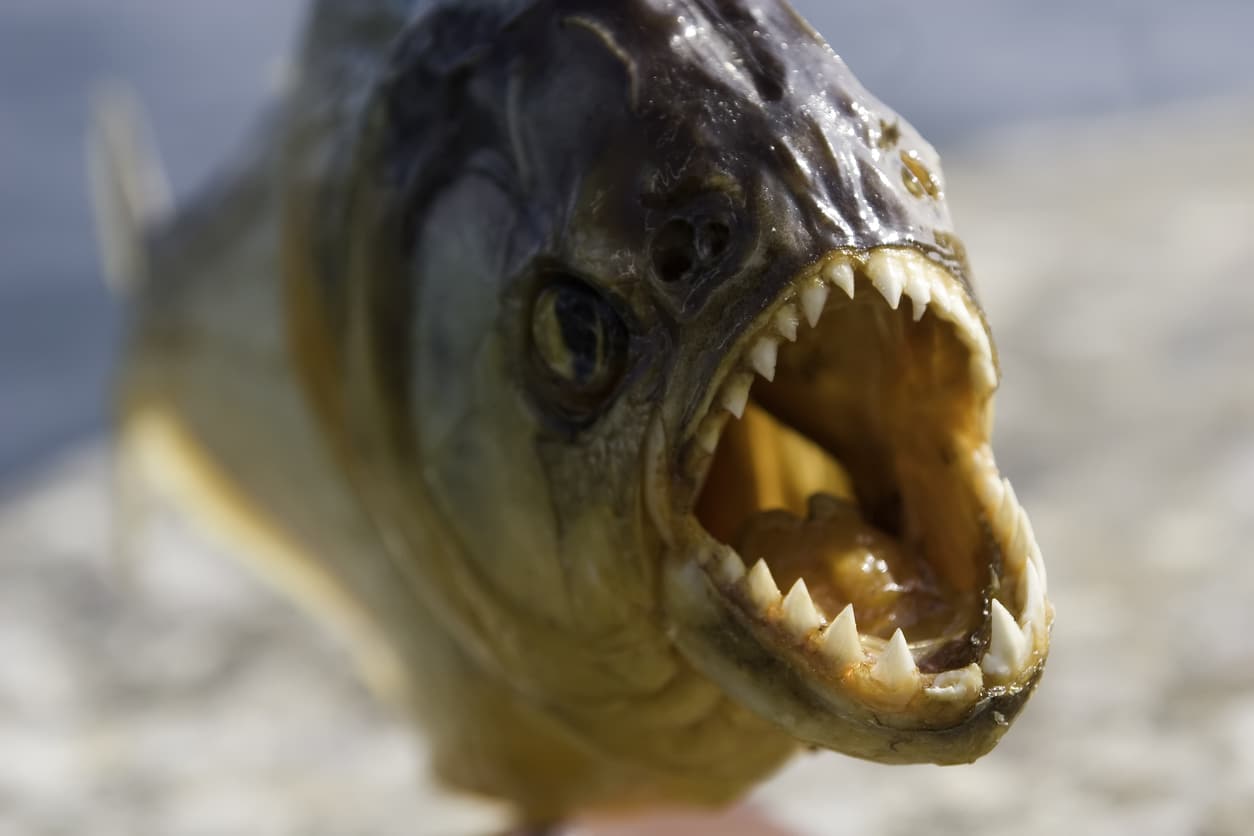
Take the black pacu (Colossoma macropomum), one of our residents at Bristol. These fish have surprisingly human-like, flat teeth that are perfect for crushing seeds and fruit. Other species use scraping mouthparts to clear algae off rocks. These adaptations are also vital for the wider environment; by grazing, these animals prevent algae from overgrowing, keeping reef ecosystems healthy and balanced.
Omnivorous feeding in aquatic animals
Omnivores are the great all-rounders of the sea, eating both plant and animal matter. Their teeth are adapted for flexibility rather than specialisation, allowing them to take advantage of whatever food is available.
At Bristol Aquarium, you can see this versatility in action with our angelfish (Pterophyllum scalare), various wrasse (Labridae) species, and sea bream (Sparus aurata). These fish might snack on algae one moment and small crustaceans or plankton the next. Even crabs belong to this group, using their hardy mouths to process a diverse menu. This adaptability is a brilliant survival strategy, helping them thrive even when their environment changes.

Unique feeding mechanisms in aquatic animals
Sometimes, traditional teeth simply aren’t enough. Several aquatic animals have ditched the standard dental plan for something more specialised:
- Archerfish: These clever hunters are omnivorous but rely on precision over biting. They shoot powerful jets of water to knock insects off overhanging branches and into the water.
- Octopus: Although they are carnivores, they don’t have teeth in the traditional sense. Instead, they use a hard, parrot-like beak to break into the shells of crabs and molluscs, relying on suction and pure strength.
- Rays: Many rays are bottom-feeding carnivores. Instead of sharp points, they have evolved thick, flat dental plates used to crush the heavy shells of shellfish found on the seabed.
What animal has the most teeth?
If we are talking about sheer numbers, sharks are certainly among the leaders. Because they regrow and lose thousands of teeth over a lifetime, their total count is simply staggering. For instance, the gentle whale shark (Rhincodon typus) has over 3,000 tiny teeth arranged in more than 300 rows, though they are so small they aren’t even used for feeding!
However, the true record-holder isn’t a shark at all. The umbrella slug (Umbraculum umbraculum), a type of sea snail, holds the record for the most teeth, producing up to 750,000 microscopic teeth on its radula (a tongue-like structure) throughout its life.
What aquatic animal has the largest teeth?
When it comes to size, the narwhal (Monodon monoceros) takes the prize. Its famous “horn” is actually a spiral tusk, a long tooth that can grow up to 3 metres. Interestingly, this tooth is used more for sensing the environment than for eating. For functional biting, the sperm whale (Physeter macrocephalus) has the largest teeth, which it uses to hunt giant squid in the deep ocean.
How teeth help aquatic animals survive
Whether it’s a ray crushing a shell or a reef fish grazing on algae, these dental adaptations are essential for survival. They allow animals to occupy specific niches in habitats ranging from sunlit coral reefs to the dark, open ocean. A real-life example of this is the parrotfish family (Scaridae); its beak-like teeth allow it to eat coral, which it then excretes as fine sand, literally helping to create the white-sand tropical beaches we love, even if it is kind of gross…

See aquatic feeding adaptations at Bristol Aquarium
There is nothing quite like seeing these incredible adaptations in person. At Bristol Aquarium, you can witness these feeding behaviours first-hand during our live feeds and educational talks.
From the silent glide of the rays to the focused hunting of our reef fish, there is always something new to discover. Come and visit us to see these unique animals in action and learn more about the amazing ways life has adapted to the deep!


