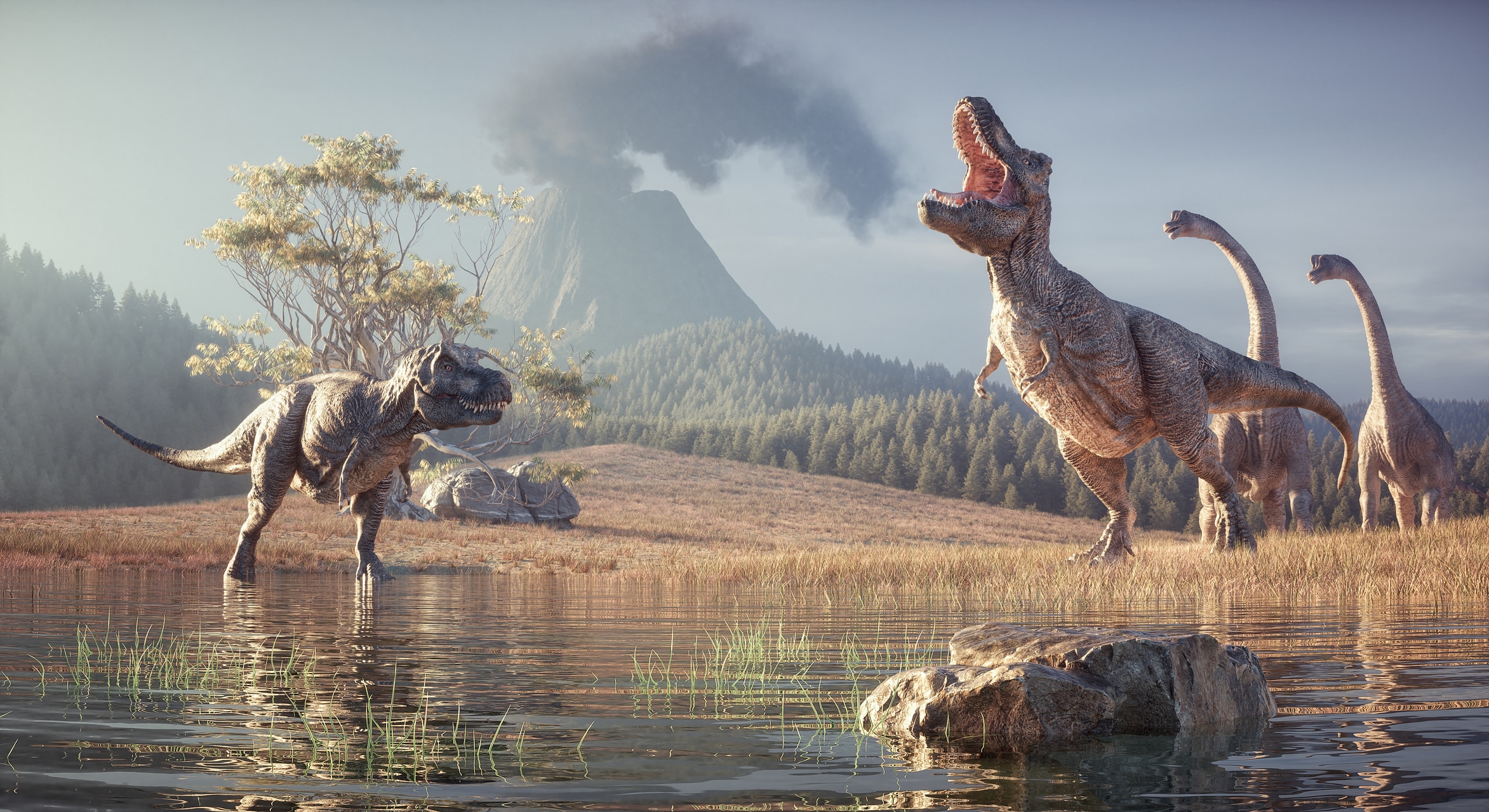
How Big Were Dinosaurs? Dinosaur Size Comparison Guide
We all know the T. rex (Tyrannosaurus rex) and the stegosaurus (Stegosaurus stenops); absolute giants of the prehistoric age, but much like the planet today, there were plenty of small and medium-sized dinosaurs that walked the earth millions of years ago.
Even though they’ve not existed for millennia, scientists have used fossils of bones and footprints to give an estimate of the size of these goliaths.
In this blog, we’re going to use common objects to give you an idea of the size of the animals that existed over 65-million years ago. And once you’re done learning about their sizes, you can learn when and where you can see accurate recreations at Bristol Aquarium.
Why Were Dinosaurs Different Sizes?
Much like modern animals, the size variety found in dinosaur species came down to factors like diet, environment, defence, and metabolism.
The era of the dinosaurs saw a perfect storm of these conditions, which allowed creatures to grow to enormous sizes. Firstly, food sources like trees and plants were abundant, which were needed to sustain huge animals, like dinosaurs. The specialised long necks of sauropods like Diplodocus (Diplodocus), allowed them to stand in one place and graze on kilos of leaves per day with little energy used.
Secondly, the generally warmer global climate allowed for more energy to be directed towards growth instead of heat regulation. These factors caused a cat-and-mouse game between predator and prey. As the prey grew, larger predators needed to evolve in order to successfully hunt. In turn, prey grew larger still to avoid predation, and so the cycle continued.
There’s also the fact that dinosaurs laid eggs, much like modern birds. This meant that rather than development taking place internally, dinosaurs could develop to enormous sizes once they’d hatched. While this left baby dinosaurs vulnerable to predators, some species adapted to lay huge clutches of more than 30 eggs at a time.
Patagotitan Mayorum Was the Largest Dinosaur
Unlike animals like the blue whale, which we can observe in their entirety to give an accurate size, the use of dinosaur fossils to estimate size isn’t an exact science. While estimates can be given, it’s impossible to say, and there’s no guarantee we’ve even discovered the fossils of the largest dinosaur to have ever existed. With that being said, what we can say for (almost) certain is that the largest dinosaurs were giant plant-eating sauropods.
The Patagotitan Mayorum roamed Patagonia over 90 million years ago, during the Early to Late Cretaceous period. Fossils found in Argentina suggest that this enormous animal would be as long as a Boeing 737 jet! This 40-metre behemoth weighed between 50 and 70 tonnes, about half that of a blue whale (Balaenoptera musculus) because of its hollow, air-filled bones.
Huge Carnivorous Dinosaurs
Now that we’ve looked at the largest dinosaurs, it’s time to take a look at the most fearsome: the carnivores! With teeth that dwarf those of modern carnivores, there’s a good reason these animals have been the subject of countless Hollywood blockbusters.
Tyrannosaurus Rex
Although smaller than the giant herbivores we talked about, the T. rex is still absolutely enormous compared to almost any animal on earth today. With a horizontal posture, its height is measured up to its hip, which is still about 4 metres tall. From its teeth-filled head all the way to its tail, the T. rex is about as long as three cars parked bumper to bumper, which is incredible to think about. This enormous size meant that they weighed between 8 and 10 tonnes.
Giganotosaurus
Despite being tipped as a T. rex killer in pop culture, the Giganotosaurus was actually very similar in size to the T. rex. Its elongated head made it marginally longer than the T. rex (about 13 metres), but there’s not enough of a size difference to accurately say it was significantly larger than it, despite its name. The key difference between the two animals is their head and their teeth. T. rex had large, banana-shaped teeth that would crush bone with a devastating bite. The Giganotosaurus, on the other hand, had teeth like a steak knife that would tear through the flesh of its prey.
Mosasaurus
The Mosasaurus is not technically a dinosaur, but it lived during the same period as the dinosaurs. This marine giant was approximately 13 metres long (just over a London Routemaster Bus) and weighed up to 10 metric tonnes – about as much as a large modern-day orca (Orcinus orca). These marine titans would feed on other large marine animals such as large fish, crustaceans, and marine reptiles.
Microraptor was the smallest non-avian dinosaur
On the other end of the spectrum, you’ll find the Microraptor, meaning “small one who seizes”. These crow-sized dinosaurs had the ability to glide between treetops and would ambush their prey from above, using their four wings to guide them. Some palaeontologists (people who study dinosaurs) believe that their foot joints and toe pads would have allowed microraptors to grab prey mid-flight, much like modern birds of prey, although this is still debated.
These small dinos weighed between 0.5 and 1.4 kilos, or about as much as a healthy domestic rabbit.

How Do Scientists Measure Dinosaur Size?
If a scientist wants to know a dinosaur’s size, they can’t just hop in a time machine to find out. Instead, they have to use careful techniques, a bit of detective work, and computer models to give an accurate assessment of how large a dinosaur might have been.
Firstly, they can compare fossilised bones to creatures that exist today. Usually, this is by using the femur (upper leg bone) or humerus (upper arm bone). The thickness of these bones gives an estimate of how much weight they could support before they would snap, which can then be used in an equation to give an overall mass of the animal.
When scientists have a relatively complete fossilised skeleton, they can scan it into computer modelling software, alongside estimations on soft tissue and organs. They use a lot of complicated maths to remove empty spaces, like air sacs and lungs, and then multiply that by the known tissue density of modern-day animals like birds or crocodiles.
Dinosaur Size Comparison Guide
Imagining these colossal dinosaurs is difficult, even with comparisons, so we’ve put together a size comparison guide to show you some dinosaurs side-by-side with a bus.

Meet the Dinosaurs at Bristol Aquarium
Bristol Aquarium isn’t just home to animals that currently exist; it’s also home to some models of animals that went extinct many millions of years ago. During a trip to Bristol Aquarium, you can spot dinos, such as Ankylosaurus (Minmi paravertebra), Spinosaurus (Spinosaurus aegyptiacus), and even an Iguanodon baby (Iguanodon bernissartensis).
These beautiful recreations give guests a chance to step into the prehistoric world to see how the earth might have looked when dinosaurs roamed it.
Megalodon at Bristol
Alongside our dinosaur models, we’ve also got a replica of an enormous megalodon (Otodus megalodon) jaw! The massive jaw gives just a taste of the incredible size the animal could grow to – 24 metres, or about as big as a modern-day blue whale. The megalodon was the largest marine predator to ever exist, with teeth 2 or 3 times the size of a modern-day great white shark (Carcharodon carcharias). They’re now extinct, but it’s fascinating to imagine such an enormous animal in the ocean, and how big their prey would have to be just to sustain themselves.
Our enormous cinema screen is actually the same size (corner-to-corner) as a Megalodon, so we named it the Megascreen in honour of the largest fish to ever swim the oceans.
Did you know, modern birds ARE dinosaurs?
All birds are descended from the same evolutionary tree as the dinosaurs, meaning if you look out your window and see a robin or a chaffinch hopping around, that’s a little modern dinosaur right in front of your eyes! The smallest living dinosaur is the bee hummingbird and the biggest is the ostrich!
Dinosaur Events at Bristol Aquarium
Our dinosaur models are hiding in our botanical house all year round, but sometimes we like to show them a little more love by hosting events, talks and tours all about dinosaurs. These events include fossil collections, puppet shows, trails, and dinosaur experts sharing their knowledge on dinosaurs.
The fun doesn’t stop there! Our interactive dinosaur VR experience allows guests to step back in time to when dinosaurs ruled the earth, coming face-to-(virtual)face with raptors and T. rex.
Our dinosaur events are annual, so keep an eye out for our next confirmed date. If you’d like to visit before our next dino event, book your tickets now to see not only our incredible model dinosaurs, but the vast species of marine life we take care of at Bristol Aquarium.