Everything You Need to Know About the Water Cycle
The water cycle is one of the most crucial natural occurrences in the world. Without it, freshwater would no longer exist on Earth, leading to the extinction of organic life. It continuously moves around the globe in a four-stage cycle.
Alongside supporting the life of animals on land, the water cycle also supports aquatic animals by replenishing habitats, regulating ocean temperatures, and cycling essential nutrients.
In this blog, we’ll detail what the water cycle is, why it’s so important and the stages of the water cycle, and what efforts you can make to learn more about the water cycle.
What is the Water Cycle?
The water cycle is the name given to the continuous solar-driven movement of water on, above, and below the Earth’s surface. This cycle has happened continuously over billions of years, meaning that we drink the same water that dinosaurs drank. This is because although the water is moving, the amount of water on Earth stays roughly the same, changing form from liquid to gas, back to liquid, and even into a solid in colder regions.
While the most obvious (and maybe annoying) part of the water cycle is rain, the oceans are arguably the most crucial aspect of the water cycle because they contain around 97% of the world’s water.
If you’re wondering if the hydrological cycle and the water cycle are related, you’d be right. In fact, they’re the same thing, with one having a slightly fancier name.

Who Discovered the Water Cycle?
Unlike things like gravity or dynamite, there’s no one person credited with the discovery or invention of the water cycle. Instead, the scientific understanding of the water cycle gradually evolved over time.
Early theories about the water cycle date back over 2,000 years, with Greek polymath Aristotle discussing early ideas about how the water that fell in the form of rain must have evaporated from somewhere, although his theories lacked the evidence to become mainstream belief.
In the 16th century, Bernard Palissy suggested that rainfall must be feeding the lakes and rivers that were around him. However, it wasn’t until the 17th century that scientists such as Pierre Perrault and Edme Mariotte carried out experiments measuring rainfall and river flow, helping confirm the modern understanding of the water cycle.
How Does the Water Cycle Work?
The water cycle is a complex process that is powered by energy from the sun, as well as gravity. However, breaking the cycle into clear stages makes it easier to understand.
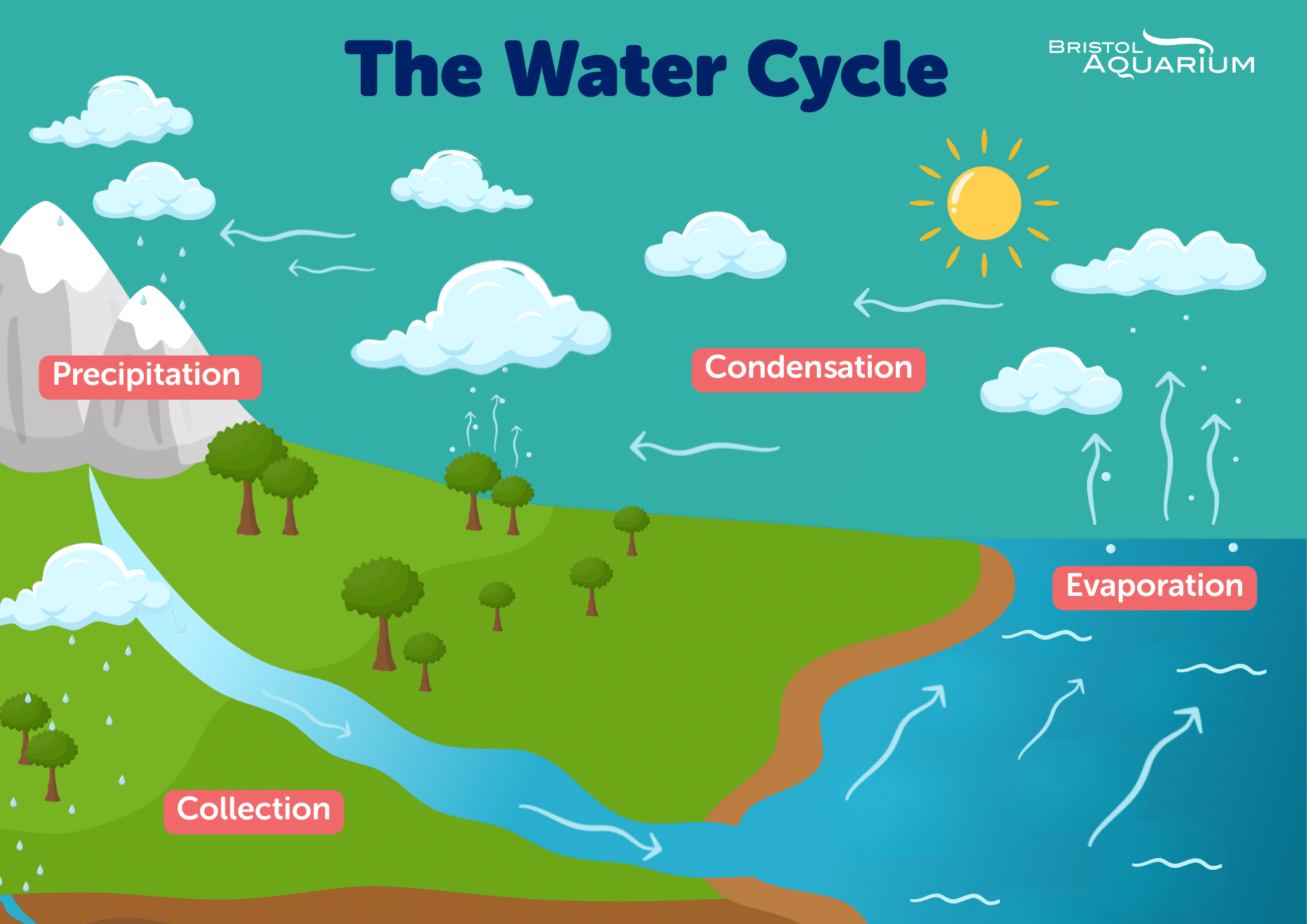
Evaporation
This incredible journey begins when heat from the sun warms the surface of our planet, turning liquid water into an invisible gas known as water vapour. While this transformation happens all around us from rivers and lakes, our vast oceans are actually the largest source of evaporation on Earth, acting as a massive engine that powers the entire process.
Condensation
As that water vapour rises higher into the sky, it begins to cool down. When it meets the chillier air of the upper atmosphere, the gas turns back into tiny liquid droplets through a process called condensation. Billions of little droplets gather together in the sky to form the fluffy white clouds you see drifting overhead.
Precipitation
Eventually, those clouds become packed with so much moisture that the droplets grow too heavy to stay afloat. Gravity then takes over, and the water falls back to Earth as precipitation. Depending on the temperature and weather conditions, this might reach the ground as refreshing rain, soft snow, icy sleet, or even hail.
Collection
Once the water has fallen, it finds its way back home by collecting in our oceans, rivers, and lakes, or even soaking deep into the ground to fill underground reservoirs. From here, the journey is ready to begin all over again as the sun starts the evaporation process once more, keeping our planet’s water moving in a never-ending loop.

Why is the Water Cycle Important?
The water cycle is essentially the Earth’s own plumbing and filtration system, and it is vital for keeping our world healthy. By moving water from the salty sea to the land, it effectively distributes the fresh water that plants, animals, and entire ecosystems need to survive. It also acts as a global thermostat, helping to regulate weather and climate patterns so that different regions of the world stay habitable.
Beyond just moving water, this cycle helps to naturally clean and filter it as it moves through various environments. Without this constant recycling of our most precious resource, life on Earth simply would not be possible. This balance is especially important for marine life, as healthy oceans are essential for maintaining a balanced water cycle that benefits every living thing.
What Role Does the Ocean Play in the Water Cycle?
When it comes to the water cycle, the ocean is undoubtedly the most dominant player on the team. In fact, around 86% of all global evaporation comes directly from the sea, which means the ocean is responsible for the vast majority of the clouds and rainfall that nourish the rest of the world.
Ocean currents and water temperatures also act as a massive steering wheel for our global weather patterns, influencing everything from local breezes to major storms. Because of this, maintaining healthy marine ecosystems is vital for environmental balance.
Here at Bristol Aquarium, we believe that learning about these marine environments helps our visitors truly understand how the health of our oceans affects the entire planet.
Water Cycle Poster

Learn More About Ocean Science at Bristol Aquarium
Understanding the magic of processes like the water cycle is the first step in appreciating just how important marine environments are to all life on Earth. From the tiniest plankton to the largest sharks, every creature depends on the delicate balance that the ocean provides.
We would love for you to come and see the wonders of the deep for yourself. We encourage all our readers to visit Bristol Aquarium to dive deeper into marine ecosystems, explore the science of our oceans, and meet the amazing animals that depend on healthy seas to thrive. Why not make a splash and plan your visit today to see how you can help protect our blue planet?